Kubera, Lord of Wealth
Guardian of treasures and divine steward — who teaches that the true riches are the inner treasures unlocked as the chakras open.
Who is Kubera?
Kubera is the Hindu god of wealth, treasures, and prosperity, the guardian of the northern direction and the king of the Yakshas (nature spirits). He rides his mongoose vehicle, carries a mace and a money pot overflowing with gold coins, and presides over the fabulous city of Alakapuri in the Himalayas, where every building is made of gold and the gardens grow wish-fulfilling trees.
In the early Vedic period, Kubera was known as a demon of evil. Through intense austerities (tapas) directed toward Lord Shiva, he transformed himself completely, earning the title Loka-pala (guardian of the world) and the stewardship of all material and spiritual treasures. His transformation is a testament to the power of sincere spiritual practice to convert even the most materialistic nature into an instrument of divine service.
True wealth is not accumulation but sharing. Kubera guards treasures only to distribute them to those who walk the path of dharma.
In Kriya Yoga, Kubera represents the inner wealth that is discovered through spiritual practice. The true treasures are not material riches but the eight siddhis (perfections) and the nine nidhis (spiritual treasures) that arise as the chakras open. The Kriya yogi becomes the wealthiest of beings, possessing the infinite riches of the Self.
The Lore of Kubera
Kubera’s Transformation
Recognising the futility of material pursuit without spiritual foundation, Kubera performed severe austerities for thousands of years, meditating upon Lord Shiva in the Himalayas. Pleased with his devotion, Shiva granted him guardianship of all the world’s treasures and the position of one of the four Lokapalas (directional guardians), protecting the north.
Kubera and the Pushpaka Vimana
Kubera possessed the Pushpaka Vimana, a legendary flying chariot that could travel anywhere in the universe at the speed of thought. This vehicle was later seized by Ravana in the Ramayana, symbolising how the powers of a yogi can be usurped by the ego if not protected by vigilance. The Pushpaka represents the subtle body (sukshma sharira) that carries the soul between realms.
The City of Alakapuri
Kubera’s capital, Alakapuri, is described in the Puranas as a city beyond imagination — streets paved with precious gems, palaces of gold, and gardens containing kalpavriksha (wish-fulfilling trees) and chintamani (wish-fulfilling jewels). Yet Kubera himself lives simply, using his wealth to support dharma and aid worthy seekers. This teaches that true prosperity serves spiritual purpose rather than feeding endless desire.
Kubera and Lakshmi
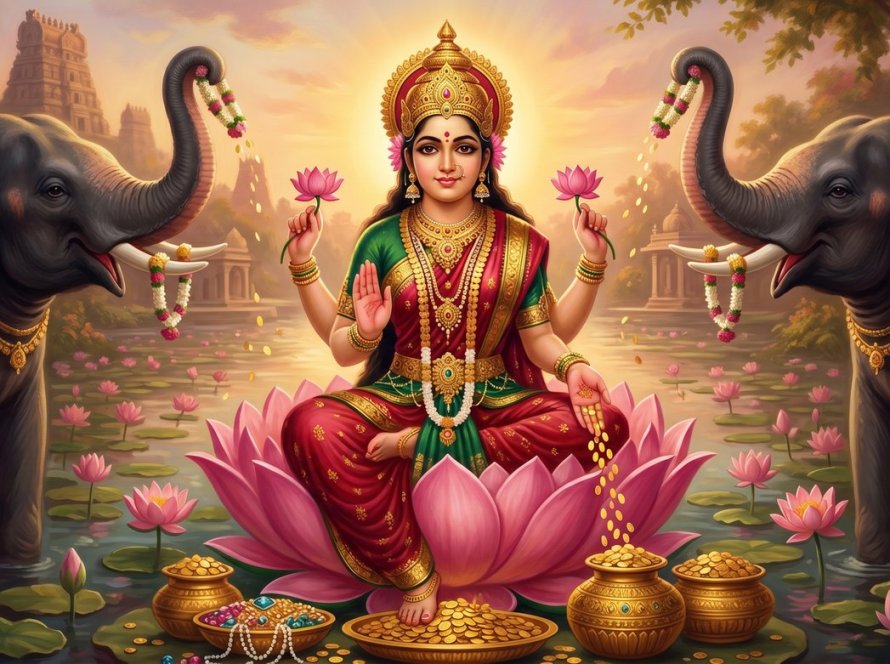
While Lakshmi is the goddess of spiritual wealth and fortune, Kubera is the steward of material riches. Together they represent the complete spectrum of abundance: Lakshmi provides the inner fulfilment that comes from spiritual practice, while Kubera manages the outer resources needed to sustain a spiritual life. The wise seeker honours both, using material wealth as a vehicle for spiritual growth.
The Inner Meaning
Inner Wealth vs. Outer Riches
In the inner yoga, Kubera represents the treasures of the subtle body. Each chakra is a storehouse of specific powers (siddhis): the Muladhara grants grounding and vitality, the Svadhisthana gives creative power, the Manipura provides will, the Anahata opens love and healing, the Vishuddha grants communication, the Ajna gives spiritual vision, and the Sahasrara contains the supreme treasure of Self-realisation.
The Nectar of the Bindu
The true treasure of the Kriya yogi is the Amrita — the nectar of immortality that flows from the Bindu at the crown chakra. This nectar is more precious than all the gold in Alakapuri, for it grants not temporary comfort but eternal freedom. When the Kriya practitioner tastes this nectar through regular practice, all outer wealth becomes insignificant by comparison.
Iconography & Symbols
Kubera, lord of wealth and treasurer of the gods, is depicted quite unlike the slender celestials: he is a stout, richly ornamented figure with a rounded belly, laden with jewels and gold. In his hands he holds a money-pot and often a mongoose (nakula) that spews forth precious gems — for in legend the mongoose is the enemy of the serpents who hoard the treasures of the earth. He is lord of the northern direction and king of the yakshas, the nature-spirits who guard hidden riches.
His plumpness and abundance signify prosperity and plenty, while the ever-flowing jewels from the mongoose's mouth carry a quieter teaching: that wealth is meant to circulate and be released, not merely stored. Kubera rules from the fabled city of Alaka in the Himalayas, high above the world of ordinary commerce.
Myths & Legends
Kubera did not begin as a god. Tradition holds that through long and severe austerities he won from Brahma the guardianship of the world's treasures and a place among the immortals — a reminder that even lordship over riches is earned through discipline. He was granted the flying chariot Pushpaka and the kingdom of Lanka.
His story takes a darker turn through his half-brother, the demon-king Ravana, who seized both Lanka and the Pushpaka chariot by force, driving Kubera north to Alaka. A close companion of Shiva, with whom he dwells in the Himalayas, Kubera is invoked as the custodian who dispenses wealth to the worlds — never its true owner, only its keeper on behalf of the gods.
The Right Use of Wealth
Kubera embodies a subtle teaching that runs throughout Indian thought: prosperity is a trust, not a possession. He is called the treasurer of the gods, not their banker for hire — he holds the world's abundance in stewardship, to be distributed where it is deserved and released where it is needed. The jewels forever pouring from his mongoose signify wealth that flows outward and so remains alive.
The tradition warns that riches hoarded in fear become like the treasure of serpents — guarded, lifeless and corrupting. Sought rightly, wealth is one of the legitimate aims of human life, a support for duty and generosity; sought as an end in itself, it binds. Kubera thus stands beside Lakshmi as a reminder that true abundance serves dharma, and that the seeker holds all things lightly, as a caretaker rather than an owner.
Frequently Asked Questions
Who is Kubera?
Kubera is the lord of wealth and treasurer of the gods, king of the yakshas and guardian of the northern direction.
What does Kubera teach about wealth?
That prosperity is a trust to be circulated, not hoarded; riches guarded in fear become lifeless.
How did Kubera become a god?
Through long austerities he won the guardianship of the world’s treasures from Brahma.