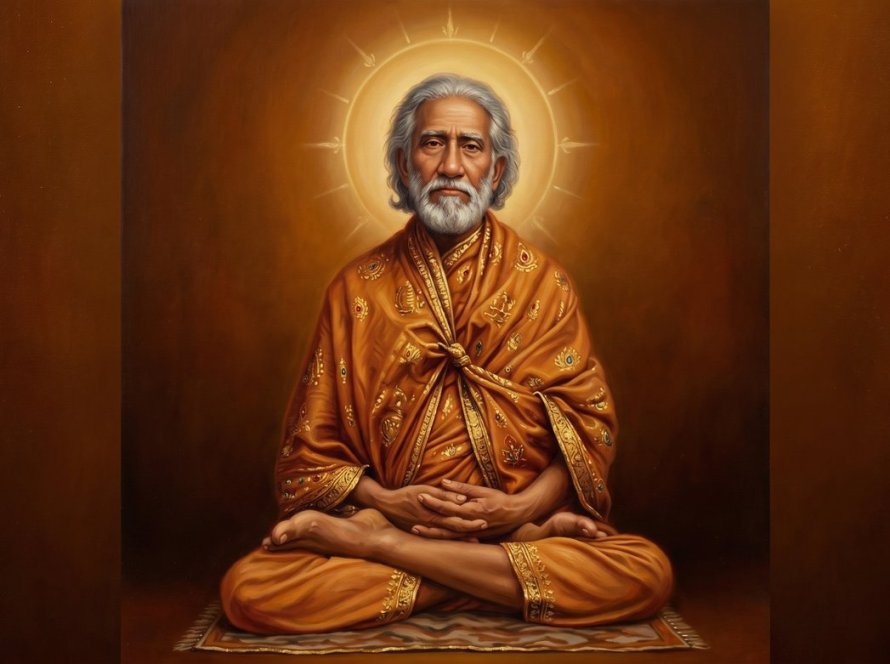
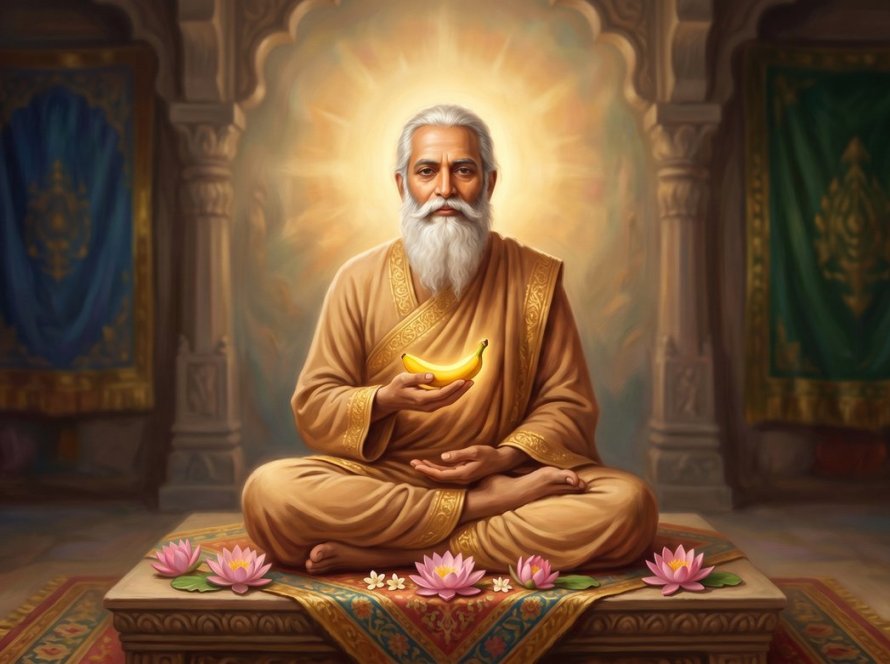
Mahavatar Babaji
Known by many names and bound by neither birth nor death — the deathless master of the Himalayas, fountainhead of the Kriya lineage, and, in the Nath tradition, the immortal Shiv-Goraksha Babaji.
Of all the figures in the Kriya Yoga tradition, none is more mysterious — or more revered — than Mahavatar Babaji. He is the deathless guru of the Himalayas: the source from whom the modern Kriya lineage flows, and, within the Nath tradition of Yogiraj Gurunath Siddhanath, the immortal Shiv-Goraksha Babaji himself.
The Deathless Master
Mahavatar Babaji is described as both ageless and eternally young. Sometimes he is formless; at other times he appears before his disciples in whatever form he chooses. No historical or scriptural record can fix the facts of his birth, identity, or life — he is primordial, mahakal, and immortal, not held captive by time or space. Adoringly addressed as Mahamuni, Tryambaka Baba, Shiva Baba, and Badua Baba, he remains engrossed in deep meditation among the caves, forests, and snow-covered peaks of the Himalayas, keeping a watchful gaze on sincere seekers.
In the Nath tradition he is called aja-purusha — the unborn — one who was never born and can therefore never die. Yet from time to time this compassionate Lord takes a form of “lightless light” to incarnate among humanity, to do what needs to be done, guarding and guiding the evolutionary blueprint of all life.
Shiv-Goraksha Babaji and the Nath Lineage
Within the Nath tradition, Babaji is known as Shiv-Goraksha Babaji, the “Nameless One” — regarded as a manifestation of Lord Shiva and the founder of the Nath order, and described as the collective spiritual essence of the nine Nath Lords combined.
His deathless body of lightless light is said to have appeared in many forms across the ages: as Adi Nath Shiva; as Kal Agni Nath around 500 B.C.; as Goraksha Nath in the era of King Shalivahan; and as Shiv-Goraksha Babaji in the ninth century. It is he who bestowed the divine alchemy of Shiva-Shakti — Kundalini Kriya Yoga — whose upward-moving breath expands consciousness while the downward-moving breath burns away past karma.
The precise identity of Babaji is understood differently across the various yoga traditions; the Nath lineage identifies him as this one immortal, ever-present Shiv-Goraksha Babaji.
His Role in the Kriya Lineage
Babaji was first made widely known to the modern world through Paramahansa Yogananda’s Autobiography of a Yogi. It was Babaji who revived the lost science of Kriya Yoga and, in the nineteenth century, initiated Lahiri Mahasaya into its liberating techniques — raising him, it is said, into the deathless realm of nirvikalpa samadhi.
Through Lahiri Mahasaya, Babaji taught a revolutionary truth: that liberation is not the monopoly of a few renunciates. The householder — living and working in the world — can attain God-realization by seeking the soul in every moment. He later appeared to Sri Yukteswar at the Kumbha Mela, addressing him as “Swamiji” and asking him to write a book uniting the wisdom of East and West — the work that became The Holy Science. And it was by his direction that Kriya Yoga was carried to the West.
One Immortal Guiding Presence
Like a director who remains in the background instructing the actors, Babaji oversees the worldly stage, appearing only rarely and to those who are ready. He roams the vast ethereal canvas of divinity, transcending all worldly distinctions of caste, class, religion, culture, and geography.
When he once wished to shed his body, his sister Mataji asked him to pledge that he would never relinquish his form until the liberation of the whole human race. As a hallmark of his boundless compassion, he promised it would be so. And so he remains — here and now, eternally to stay — the silent, deathless guardian at the head of the Kriya lineage.