Avatara: The Full Descent of the Divine
The word avatāra comes from the Sanskrit ava (“down”) and tṛ (“to cross over”) — literally a descent, a crossing down from the eternal into the world of form. In the Hindu and yogic traditions it names those rare moments when the Divine itself steps into creation to set the world right. As Sri Krishna promises in the Bhagavad Gita, whenever righteousness declines and unrighteousness rises the Lord manifests himself age after age — to protect the good, restrain the wicked, and re-establish dharma (Gita 4.7–8).
What Makes an Avatara
A true avatara is a direct and full descent of God — what the scriptures call a sakshat or purna incarnation. Such a being is not an ordinary soul who grows holy and is later filled with grace; he or she is born as the very spirit of God, divine from the first breath. As Yogiraj Gurunath Siddhanath explains in his talks on the Kalki Avatar, “in an avatar you are the spirit of God — you are born like that.” This is the mark that sets the avatara apart from the avesha, the empowered soul into whom the Divine descends later in life.
Full and Partial Descents
The tradition recognises degrees of descent. A purna avatara expresses all the qualities and opulences of the Divine in their fullness; Krishna is revered as such a one — the svayam bhagavan, God in person, complete and undiminished. An amsha avatara is a partial descent, in which only a portion of the divine power is revealed for a particular purpose. In every case the avatara comes with a mission: to restore the balance of the three gunas and steady a world that has tilted into disorder.
The Dashavatara — Ten Classic Descents
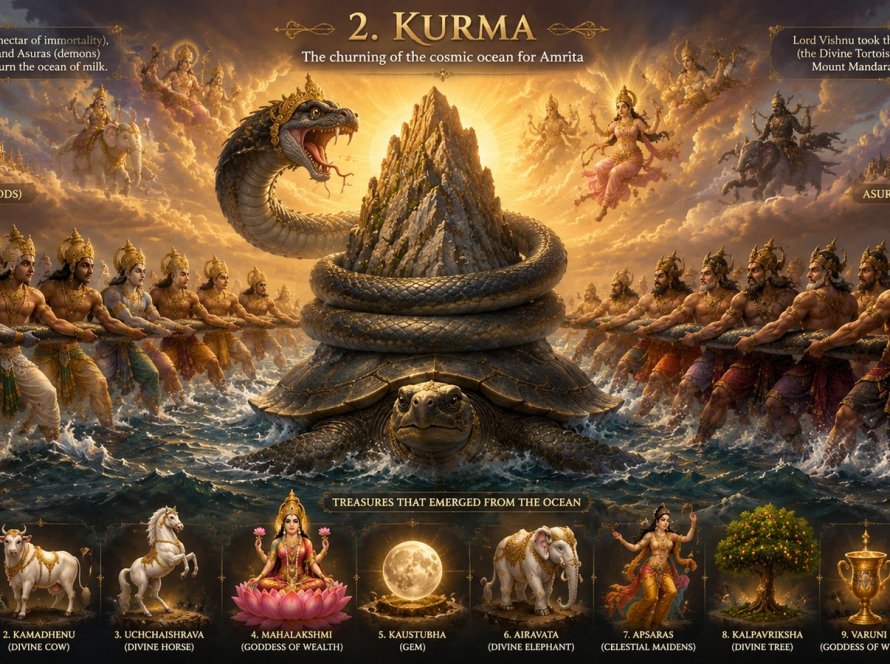
The most celebrated avataras are the Dashavatara, the ten descents of Vishnu who appear in age after age to rescue creation: Matsya the fish, Kurma the tortoise, Varaha the boar, Narasimha the man-lion, Vamana the dwarf, Parashurama the warrior-sage, Rama, Krishna, the Buddha (in many lists), and finally Kalki — the avatar still to come.
Those Held to Be Avataras
Among the beings the tradition honours as full descents of the Divine:
- Rama — the prince of Ayodhya and the very embodiment of dharma, born to overcome Ravana and to model a righteous life.
- Krishna — regarded as the purna avatara, the complete descent, whose words became the Bhagavad Gita.
- Narasimha — the man-lion who burst forth from a pillar to protect his young devotee Prahlada.
- Matsya, Kurma, Varaha, Vamana — the earlier descents, each restoring cosmic balance in its own age.
- Chaitanya Mahaprabhu — revered in the Gaudiya Vaishnava tradition as the avatara of the present age.
- Kalki — the final descent, born as the very spirit of God, who will end the dark age and establish the Satya Yuga.
Why the Avatara Comes
The avatara does not descend for his own sake but for the world. He comes to lift the weight of inertia and unrest from the earth, to rebalance the emotional, mental, and intuitional life of humanity, and to rekindle goodwill and peace. Where an ordinary teacher points the way, the avatara is the way made flesh — the Divine choosing, for a time, to wear a human form so that creation may find its balance again.
Related reading: Avesha: When the Divine Empowers a Soul · The Kalki Avatar.