Krishna, the Divine Cowherd
Supreme incarnation of love, wisdom, and cosmic joy — the blue light of the spiritual eye and the flute-song that calls the soul home.
Who is Krishna?
Lord Krishna is the eighth avatar of Lord Vishnu and one of the most widely revered and beloved deities in all of Hinduism. As the divine cowherd of Vrindavan, he stole butter and hearts with equal ease. As the charioteer of Arjuna on the battlefield of Kurukshetra, he delivered the Bhagavad Gita, the supreme scripture of yoga. As the king of Dwarka, he demonstrated the perfection of dharma in all relationships.
Krishna’s divine play (lila) encompasses every aspect of life: romance, friendship, warfare, statecraft, and supreme wisdom. His flute call represents the irresistible divine attraction that draws souls back to their source. The gopis who left everything to dance with him symbolise the soul’s yearning for union with the divine.
Whenever righteousness declines and unrighteousness prevails, I manifest myself. For the protection of the good, the destruction of the wicked, and the establishment of dharma, I am born in every age.Bhagavad Gita 4.7–8
In Kriya Yoga, Krishna represents the Divine Self that resides in the spiritual eye — the blue light (Krishna means “dark-blue”) seen in deep meditation. His flute is the cosmic sound (Anahata Nada) that calls the practitioner deeper into the inner kingdom.
The Lore of Krishna
The Birth of Krishna
Krishna was born in a prison cell in Mathura, where his parents Devaki and Vasudeva were imprisoned by the tyrant king Kamsa. At midnight on the eighth day of the dark fortnight, Krishna appeared with four arms holding his divine weapons. By divine arrangement, the guards fell asleep, the chains broke, and the doors opened. Vasudeva carried the infant across the flooded Yamuna river — which parted to make way — to the safety of Gokul, where Nanda and Yashoda raised him as their own.
Krishna and the Gopis
The Rasa Lila — the divine dance of Krishna with the gopis — is the supreme expression of prema bhakti (divine love). Krishna multiplied himself so that each gopi felt she was dancing with him alone. This represents the truth that God is simultaneously one and many — the One Self that individuates into countless souls while remaining undivided. The gopis’ complete surrender of ego in love is the model of spiritual devotion.
The Bhagavad Gita
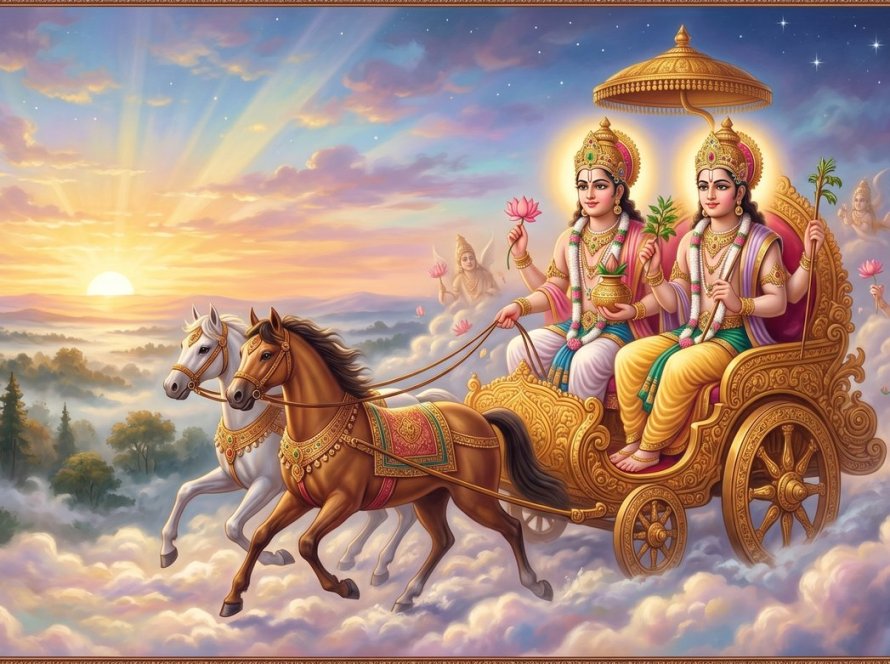
On the eve of the great Mahabharata war, Arjuna was overcome with despair at the prospect of killing his own relatives. Krishna, as his charioteer, delivered the eighteen chapters of the Bhagavad Gita — teaching the paths of Karma Yoga (selfless action), Bhakti Yoga (devotion), Jnana Yoga (wisdom), and Dhyana Yoga (meditation). The Gita is the essential scripture for all yogis, including Kriya practitioners.
Krishna’s Cosmic Form
When Arjuna asked to see Krishna’s true nature, the Lord granted him divya drishti (celestial vision). Arjuna beheld the entire universe — past, present, and future — contained within Krishna’s body. He saw countless suns and moons, the dissolution of worlds, and the birth of new ones. Overwhelmed, he begged Krishna to return to his gentle form, realising that the human mind can only bear so much of the infinite.
The Inner Meaning
The Blue Light of the Spiritual Eye
In meditation, the Kriya practitioner beholds a field of deep blue light at the point between the eyebrows — the Kutastha Chaitanya. This is Krishna’s true form: not the historical figure but the eternal consciousness that pervades all things. When the practitioner enters this blue field, they begin to perceive the cosmic form within their own spiritual eye.
The Flute as Cosmic Sound
Krishna’s flute is the Anahata Nada — the unstruck cosmic sound heard in deep meditation. Just as the gopis left everything upon hearing Krishna’s flute, the yogi must withdraw attention from all external objects when the inner sound calls. This withdrawal (pratyahara) is the essential prerequisite for the higher stages of Kriya practice.
Iconography & Symbols
Krishna is portrayed with a complexion of dark blue or deep cloud-grey — the name Krishna itself means 'the dark one' or 'the all-attractive.' He wears a peacock feather in his crown, golden-yellow silks (pitambara) and a garland of forest flowers, and stands in the graceful three-bent tribhanga pose. In his hands he holds the bamboo flute (bansuri) whose song calls the soul home.
As the cowherd of Vrindavan he is surrounded by cattle and gopis, earning the names Govinda and Gopala; as the prince of Dwaraka and charioteer of the Gita he bears the conch and discus of Vishnu, whose eighth avatar he is. The flute — hollow, empty of self, and therefore able to carry the divine breath as music — is his central symbol: the soul emptied of ego becomes an instrument for the song of God.
Myths & Legends
Few figures in world scripture are loved through so many moods as Krishna. As an infant he is the playful butter-thief of Vrindavan; as a boy he lifts Mount Govardhana on one finger to shelter the villagers from Indra's storm, and dances upon the hood of the serpent Kaliya to cleanse the poisoned river. In the moonlit Raas Lila he multiplies himself so that each devotee feels the Divine dancing with her alone — an image of the one Self present fully within every heart.
As a youth he slays the tyrant Kamsa, and as a man he becomes the friend, kinsman and guide of the Pandavas in the Mahabharata. Across every story runs a single thread: the Divine enters the ordinary world — its play, its danger, its friendship and its war — and transforms it from within.
Krishna and the Bhagavad Gita
Krishna's supreme gift to humanity is the Bhagavad Gita, spoken on the battlefield of Kurukshetra. When the warrior Arjuna, overcome with despair, lays down his bow rather than fight his own kinsmen, Krishna — serving humbly as his charioteer — reveals the timeless science of the soul. He teaches the paths of selfless action (karma yoga), devotion (bhakti yoga) and knowledge (jnana yoga), and shows that the Self is never born and never dies.
It is here that he makes his great promise: whenever righteousness declines and unrighteousness rises, the Divine takes birth in every age to restore the balance. The Kriya masters have always held the Gita especially dear, reading Krishna the charioteer as the indwelling Self that guides the awakening seeker through the battle of life toward liberation.
Frequently Asked Questions
Who is Krishna?
Krishna is the eighth avatar of Vishnu, the divine teacher of the Bhagavad Gita and the beloved cowherd of Vrindavan.
What did Krishna teach in the Gita?
The paths of selfless action, devotion and knowledge, and the deathless nature of the Self.
What does Krishna’s flute symbolise?
The soul emptied of ego, through which the divine music can freely sound.