Vishnu, the Preserver
The sustaining power of the cosmos — who descends again and again to restore righteousness whenever darkness rises.
Who is Vishnu?
Vishnu is the Preserver — one of the three great gods of the Hindu Trinity. His role is to sustain the cosmic order (dharma) and to descend into the world whenever that order is threatened. He is depicted as a serene blue-skinned deity, reclining upon the thousand-headed serpent Ananta in the cosmic ocean, with his consort Lakshmi at his feet.
Vishnu’s primary attribute is his commitment to incarnation. Unlike the distant Creator or the ascetic Transformer, Vishnu enters the stream of history personally, taking form as an avatar whenever the world needs saving. This makes him the most approachable of the great gods — the deity who walks among us, who suffers with us, and who shows us the path through his own example.
The Lore of Vishnu
The central myth of Vishnu is the churning of the cosmic ocean (Samudra Manthan). The gods and demons churn the ocean of milk to extract the nectar of immortality, and Vishnu, in his tortoise incarnation Kurma, supports Mount Mandara on his back as the churning rod. This story symbolises the cooperative effort of all beings — divine and demonic — to extract wisdom from the depths of existence.
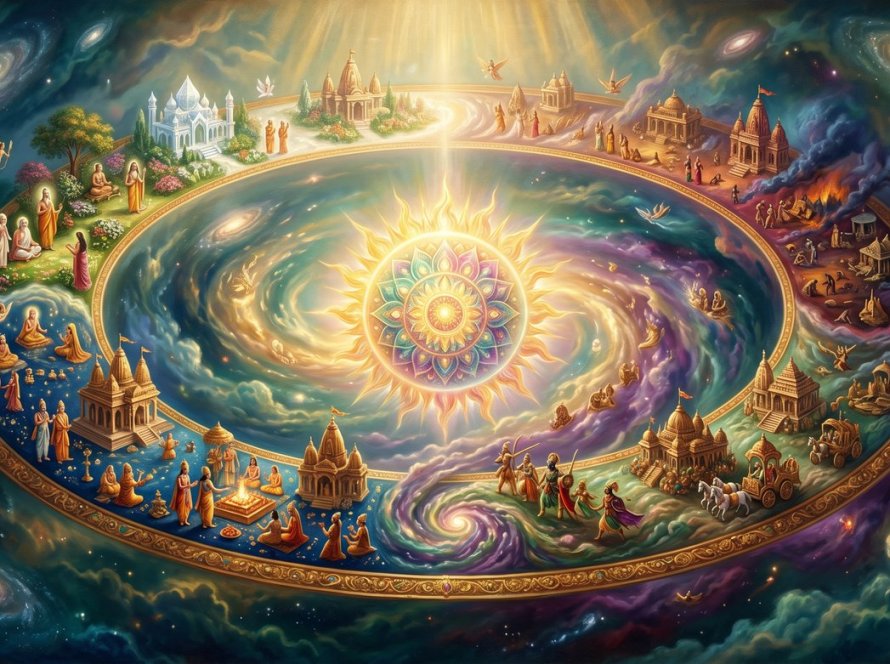
Vishnu’s most celebrated aspect is his ten incarnations — the Dashavatara — which tell the story of evolution itself: from fish to tortoise to boar to human form, and finally to the divine teacher. The two most beloved avatars are Rama, the ideal king of the Ramayana, and Krishna, the divine charioteer of the Bhagavad Gita.
The Inner Meaning
For the Kriya yogi, Vishnu represents the sustaining power of the practice itself. Just as Vishnu preserves the cosmic order, regular practice preserves the inner order — the peace, clarity, and energy that arise from daily meditation. The yogi learns that enlightenment is not a single explosive event but a sustained, gradual transformation — preserved day by day, breath by breath.
Vishnu’s incarnations also teach that the Divine adapts to every age. What was appropriate for the Treta Yuga (Rama) was different from what was needed in the Dwapara Yuga (Krishna). The yogi understands that the path must be adapted to the capacity of the seeker — one teaching for beginners, another for advanced practitioners, each appropriate to its time.
Iconography & Symbols
Vishnu is recognised by his serene, dark-blue complexion — the colour of the infinite sky and the fathomless ocean, signifying that which is boundless. His four arms bear the emblems of his cosmic office: the conch (shankha) Panchajanya, whose sound is the primal vibration OM; the spinning discus (chakra) Sudarshana, the wheel of time that cuts through illusion; the mace (gada) Kaumodaki, the power of cosmic law; and the lotus (padma), symbol of creation's unfolding and of liberation.
Upon his chest rest the Kaustubha jewel and the curl of hair called Shrivatsa. In his aspect of cosmic rest he reclines upon the coils of the thousand-headed serpent Ananta ('the endless') floating on the milk-ocean of pure potential, while the lotus of a new creation grows from his navel. His mount is Garuda the eagle, his consort is Lakshmi, and his eternal abode is Vaikuntha.
The Ten Avatars
Vishnu's most celebrated teaching is that the Divine descends into the world whenever it is needed. As Krishna declares in the Bhagavad Gita, whenever dharma declines and adharma rises, the Lord takes birth from age to age. These descents are the avatars, and tradition counts ten principal ones (the Dashavatara).
They rise through a ladder of evolution: Matsya the fish, who saves the seed of life from the flood; Kurma the tortoise, who supports the churning of the ocean; Varaha the boar, who lifts the drowned earth; Narasimha the man-lion, who defeats tyranny where neither man nor beast could; Vamana the dwarf, who reclaims the worlds in three strides; Parashurama the axe-bearing sage; Rama, the ideal king; Krishna, teacher of the Gita; the Buddha; and Kalki, the avatar yet to come. Read inwardly, the sequence mirrors the soul's own ascent — from the waters of the unconscious to the fully awakened being.
Myths & Legends
Among the best-loved stories of Vishnu is the churning of the milk-ocean (Samudra Manthana), in which gods and demons together churned the cosmic sea to win the nectar of immortality. Vishnu became the tortoise Kurma to support the churning-mountain, and later appeared as the enchantress Mohini to ensure the nectar reached the gods.
In the tale of Vamana, the dwarf-brahmin asked the generous demon-king Bali for only as much land as he could cover in three steps — then expanded to cosmic size and reclaimed the worlds, honouring Bali's devotion with the third stride. And in the story of Gajendra, an elephant seized by a crocodile cried out to Vishnu with a single lotus; the Lord came instantly, teaching that the sincere cry of the helpless soul is never unheard. Each legend turns on the same note: the preserving power answers those who turn to it in trust.
Frequently Asked Questions
Who is Vishnu?
Vishnu is the preserver of the Hindu Trinity, who maintains cosmic order and descends as avatars whenever dharma declines.
What are the ten avatars of Vishnu?
The Dashavatara: Matsya, Kurma, Varaha, Narasimha, Vamana, Parashurama, Rama, Krishna, Buddha and Kalki.
What does Vishnu hold in his four hands?
The conch, discus, mace and lotus — symbols of sound, time, power and creation.