


Pranayama: The Control of Life-Force (Limb 4 of Ashtanga Yoga)
The fourth limb of Ashtanga Yoga — and the very heart of Kriya practice. Pranayama is the regulation and refinement of the life-force through the breath, the hinge on which the whole path turns from outer to inner.
More than breathing
The word joins prana, the universal life-force, with ayama, expansion or control. Pranayama is therefore not merely “breath exercises” but the mastery of the life-force through the breath. For breath is the visible handle on the invisible prana — and, as we explore elsewhere, the breath and the mind rise and fall together. Calm and refine the breath, and the mind grows still of its own accord.
The lever on the mind
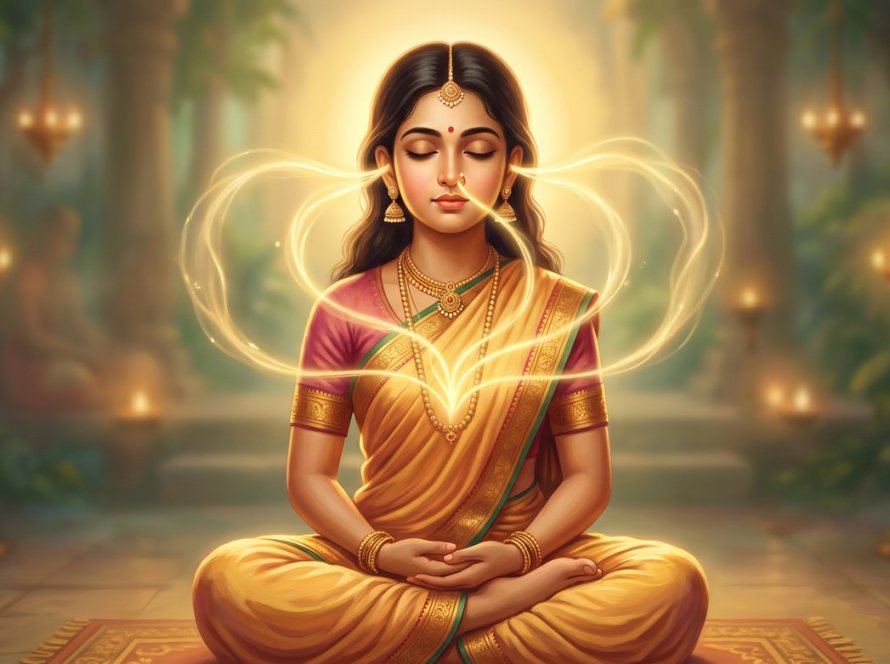
This is why pranayama is so powerful. Where the earlier limbs work gradually on conduct and posture, pranayama reaches the mind directly through its twin, the breath. By lengthening, smoothing, and quieting the breath — and by balancing its flow through the solar and lunar channels — the restless energies of the senses are gathered and drawn inward and upward along the spine. Patanjali says that through pranayama the veil over the inner light grows thin (Yoga Sutras 2.52), and the mind becomes fit for concentration.
The heart of Kriya Yoga
It is precisely here that Kriya Yoga concentrates its power. Kriya is, in essence, an advanced and sacred form of pranayama: a technique of circulating the life-force around the spine that magnetises the spinal centres and turns consciousness inward far faster than ordinary effort. This is why Kriya is called a “short-cut” through the eight limbs — by working directly with prana, it accelerates the interiorisation that the later limbs describe. The unfolding stages of this inner journey are traced in From Breath to Bliss.
Toward the breathless state
As pranayama deepens, the breath becomes finer and finer, until at the height of meditation it may grow so subtle as to seem almost to cease — a natural, effortless stillness the yogis call the breathless state. This is not a holding of the breath by force but its spontaneous quieting as the mind is absorbed. In that stillness, prana rests, the senses fall silent, and the way opens to the inner limbs.
A word of care
Because pranayama works with subtle and potent energies, the genuine techniques — and Kriya above all — are traditionally received from a qualified teacher and practised under guidance, never forced or improvised from fragments. Gentle awareness of the natural breath, however, harms no one and is a beautiful place to begin.
Related reading: Mudras for Meditation.
Frequently Asked Questions
What is pranayama?
Pranayama is the regulation and control of prana, the life-force, usually approached through the breath — the fourth limb of yoga.
Does pranayama just mean breathing exercises?
Breath is the handle, but pranayama is really the mastery of the subtle life-force that moves behind the breath.
Why is pranayama important?
Breath and mind move together; by steadying the life-force the yogi stills the mind and draws awareness inward.

1 Comment