


Ida, Pingala & Sushumna: The Three Rivers of Breath
The yogis mapped an inner geography long before modern science mapped the nerves. At its heart flow three subtle rivers of life-force — Ida, Pingala, and the sacred Sushumna.
The rivers of life-force
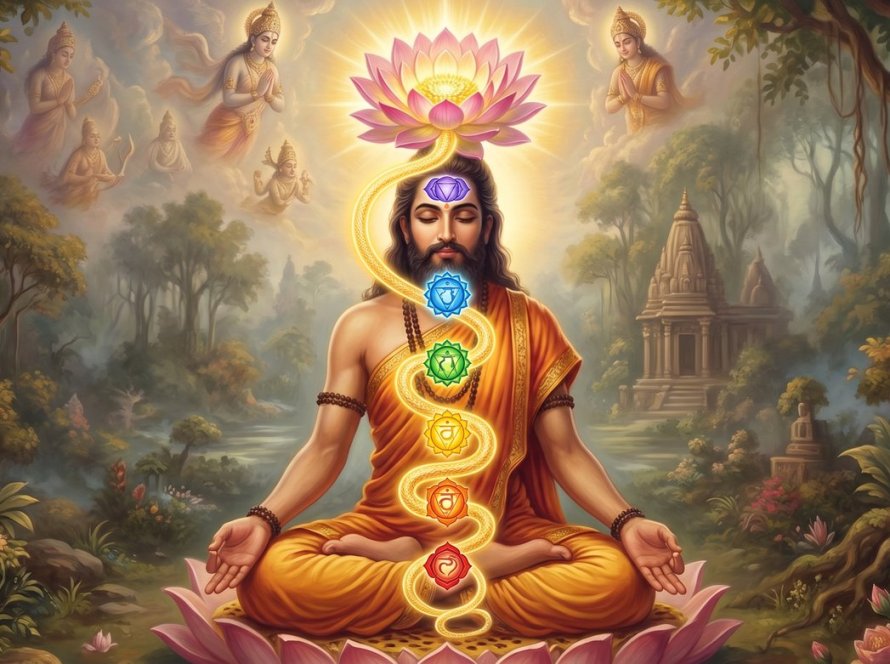
According to yogic anatomy, the life-force (prana) circulates through the subtle body along channels called nadis. Of the thousands described, three are supreme, and all of them run along the spine. Ida winds up the left side, Pingala up the right, and between them rises Sushumna, the central channel — the royal road of the awakened soul. The image is ancient and precise: two currents spiralling around a central staff, a symbol echoed the world over.
The lunar and the solar breath
Ida and Pingala are a study in opposites. Ida is the lunar channel — cooling, calming, receptive, associated with the left nostril and the quieter, reflective side of the mind. Pingala is the solar channel — warming, energising, active, associated with the right nostril and outward effort. You can observe their rhythm in your own body: through the day the breath flows more freely through one nostril, then the other, as these currents rise and fall. All of nature’s dualities — rest and activity, cool and warm, moon and sun — play out in these two streams.
Why balance matters
When one current dominates for too long, the mind tilts with it — too much Pingala and we burn with restlessness; too much Ida and we sink into dullness. Much of pranayama is, in effect, the art of balancing these two flows so the mind comes to rest in the middle. This is why so many breathing practices work with the two nostrils and the rhythm of the breath: equilibrium between sun and moon is the doorway to something higher.
The opening of Sushumna
For when Ida and Pingala come into balance, the central channel, Sushumna, can open — and this is the great event of the inner life. It is up this awakened central passage that kundalini, the dormant spiritual energy, is said to rise, passing through the chakras toward the spiritual eye and the crown. The whole architecture of Kriya meditation is built around gathering the scattered life-force into this central channel and drawing it upward. The unbalanced breath keeps consciousness bound to the body; the balanced breath sets it free.
From two into one
There is a beautiful simplicity at the centre of this map. The spiritual journey, told in the language of the nadis, is the journey from two into one: from the restless oscillation between opposites into the still, unified current of Sushumna. The formal techniques for working with these channels are subtle and powerful, and are rightly learned through initiation from a teacher — but the principle is one anyone can feel the moment the breath grows balanced and the mind, for once, falls quiet.
The Shiva-Shakti Pranayama of Kundalini Kriya Yoga balances the ida and pingala currents and draws the awakened energy up the sushumna toward the Self.

1 Comment