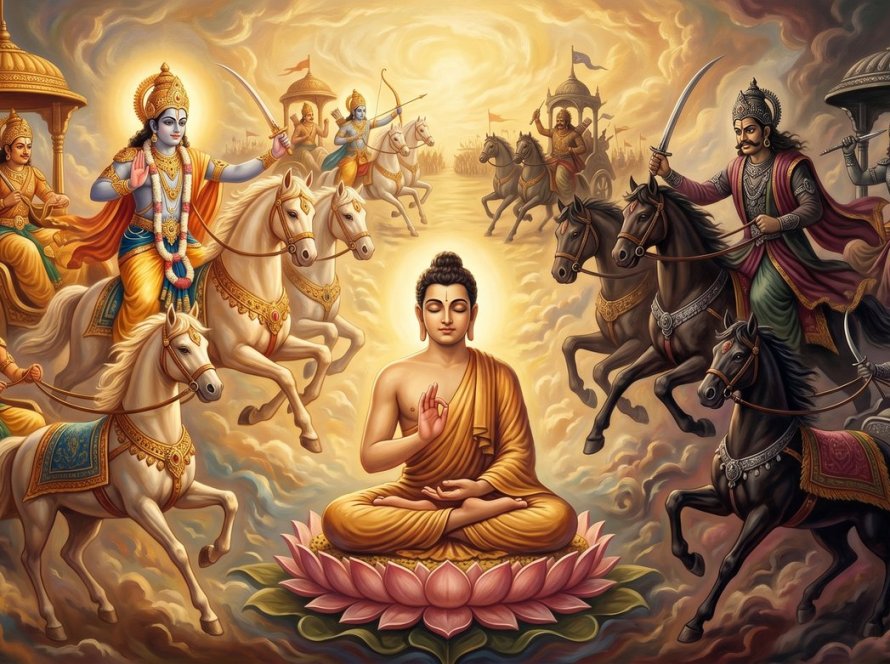
The Bhagavad Gita— Chapter 12: Bhakti Yoga (The Yoga of Devotion)
Chapter 12 of the Bhagavad Gita, Bhakti Yoga (“The Yoga of Devotion”), is the shortest chapter — just 20 verses — yet Krishna calls the path it describes the surest and sweetest of all.
The personal or the impersonal?
Arjuna asks: who are the better yogis — those who worship the personal God with form and love, or those who meditate on the formless, unmanifest Absolute? Krishna answers that both reach Him, but that the path of the formless is “more difficult for embodied beings to attain.” For most hearts, loving devotion to the personal Divine is the natural and surer way.
The dearest path
“Fix your mind on Me alone,” Krishna says, “and you shall dwell in Me hereafter.” He then gives a beautifully practical, graded teaching for those who cannot yet hold the mind steady (12:8–12): if you cannot fix the mind on Me, practise repeatedly (the yoga of practice); if you cannot practise, work for My sake; if even that is beyond you, then renounce the fruits of all action, with a self-controlled mind. Each step is open to everyone, wherever they stand.
The marks of the true devotee
The chapter closes with one of the most beloved passages in the Gita — the qualities of the devotee who is dear to God (12:13–20): one who hates no creature, who is friendly and compassionate, free from ego and possessiveness, even-minded in pleasure and pain, ever content, forgiving, self-controlled, and firm in resolve; one whom the world does not disturb and who does not disturb the world. “Such a devotee is dear to Me.”
For the Kriya yogi
Bhakti is the love that makes every technique come alive. The Kriya masters teach that devotion and method are two wings of one bird — the breath-science gives the means, and love gives the longing that carries the soul home. Return to the Bhagavad Gita overview.
This is part of our complete Bhagavad Gita summary of all 18 chapters.