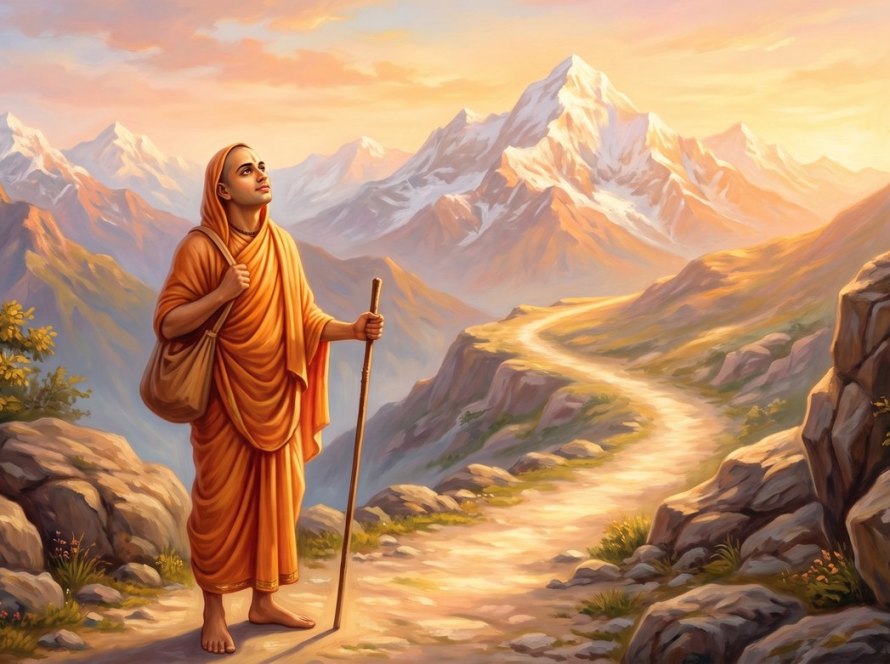
Ishvara Pranidhana
Discipline and self-study can carry a seeker far — but not all the way home. Yogiraj Gurunath Siddhanath explains the third and crowning discipline of Kriya Yoga: the total offering of oneself to God and Guru.
Yogiraj Gurunath Siddhanath on ishvara pranidhana, the third self-directed discipline of Kriya Yoga.
We have walked the first two disciplines of Kriya Yoga. Tapascharya — self-directed discipline — builds a reservoir of good karma. Svadhyaya — self-study — refines the ego and the intellect until the buddhi begins, at last, to glimpse the Self. Now Gurunath turns to the third and final portion: ishvara pranidhana.
And here he says something striking. Tapas and svadhyaya are of real value — but on their own, they cannot reach the final goal.
All these things are of no avail to reach the final goal — unless you have a total surrender, an offering of body, mind and soul to God and Guru.— Yogiraj Gurunath Siddhanath
When effort is not enough
This is the great turn of the spiritual path. Effort takes you to the threshold; only surrender carries you across it. Patanjali names this surrender ishvara pranidhana — devotion to the Lord. And, Gurunath adds, when a seeker truly cultivates these qualities of surrender, they are drawn "electromagnetically" toward the Satguru, because the Satguru is one with Ishwara.
Crucially, this is not more technique. "It does not mean you must only do Kriya Yoga, the Maha Mudra and all that," he says. It means attending to the Anandakanda — the secret lotus of bliss within the heart. This is the seat of devotion, the place of feeling. The heart center, and the offering of love to God, is what the tradition also calls bhakti yoga.
The paradox of the heart
But here lies a paradox. The same heart that is the seat of devotion is also where the ego resides. This is the dichotomy at the centre of the spiritual life — and Gurunath does not try to resolve it by force. Instead, he turns the ego into an ally.
If the ego can be convinced of the sweetness of devotion — "the nectar of bhajan and chanting and bhakti" — then that very ego will propel you toward your divine destination. When you chant, the lotus of the heart opens, and the knot of the heart, the Vishnu granthi, begins to loosen. Devotion does what force cannot.
The refining of the ego
What is the ego? Gurunath defines it simply: the feeling of "I, me, mine" — the sense that takes ownership of everything. It is not destroyed in Kriya Yoga so much as purified, rising through the three gunas, the three qualities of nature.
Through ishvara pranidhana the ego of inertia is left behind, purified into the ego of activity, and that in turn into the luminous, sattvic ego. The devotee who declares "Shiva is mine — morning Shiva, night Shiva, I live Shiva, I die Shiva" has reached this radiant state. The focus is complete. And yet — the "I" is still there. It is a pious ego, but an ego nonetheless.
The story of Tulsidas
To illustrate this most subtle stage, Gurunath tells a beloved story. Goswami Tulsidas — author of the Ramcharitmanas and a diehard devotee of Lord Ram — was once taken to a beautiful temple of Lord Krishna, who stood there with his flute, radiant beside Radha.
Tulsidas looked upon the form and said, in effect: "O Krishna, what can I say of your beauty and glory? You are wonderful upon your throne. But Tulsi will only bow if you hold a bow and arrow, like Lord Ram. If you hold a flute, I will not bow."
This is the ego of luminosity — devotion so pure it has become attached to a single, beloved form. It is a high and holy state. And still, Gurunath says, even this must be released. The image of Ram and the image of Krishna must finally merge into the one integrated consciousness of the whole universe — call it Shiva, call it Parameshwar, call it God.
Shiva belongs to the whole universe. He is the integrated consciousness of the whole universe — you cannot own him.— Yogiraj Gurunath Siddhanath
Heaven and hell in your own mind
Gurunath reframes the old language of good and evil in the clearest possible terms. Anything that integrates your consciousness, gathering it toward the bliss of God, is the upward path. Anything that disintegrates or scatters it into the distractions of worldly affairs is, metaphorically, the downward one.
"Satan and God are just words," he says. "It is all about integrated and disintegrated consciousness. A distracted mind leads to hell, and a concentrated mind leads to heaven." Heaven and hell are not distant places. They are states of your own mind.
The three become one path
And so the teaching comes full circle. Kriya Yoga consists of these three disciplines together — tapas, svadhyaya, and ishvara pranidhana. The first disciplines the body, the second purifies the mind, and the third surrenders both, along with the soul, to the Divine. Discipline and study prepare the vessel; surrender fills it with grace.
Hamsa Info is an independent, non-commercial resource. The actual Kriya techniques referred to here are given directly by the Satguru at initiation and are not taught online.