Svadhyaya
The second discipline of Kriya Yoga is self-study. But Yogiraj Gurunath Siddhanath turns the idea on its head with a single question: who is studying whom?
Yogiraj Gurunath Siddhanath on svadhyaya, the second self-directed discipline of Kriya Yoga.
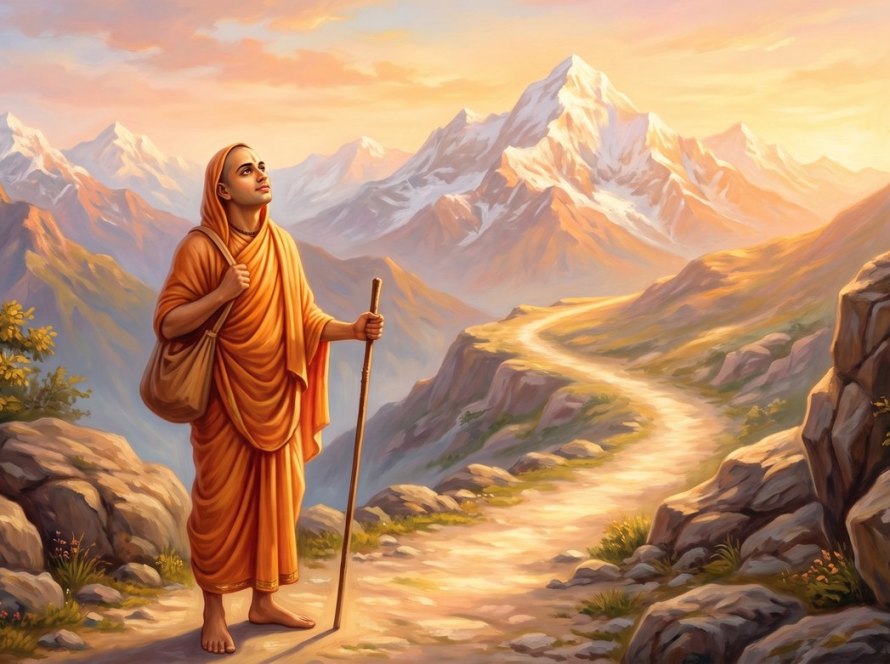
If tapascharya is the discipline of the body — waking, bathing and sitting for sadhana at a fixed hour — then svadhyaya is the discipline of the mind. It is the second of the three self-directed disciplines that make up Kriya Yoga, and Gurunath calls it "the very important part."
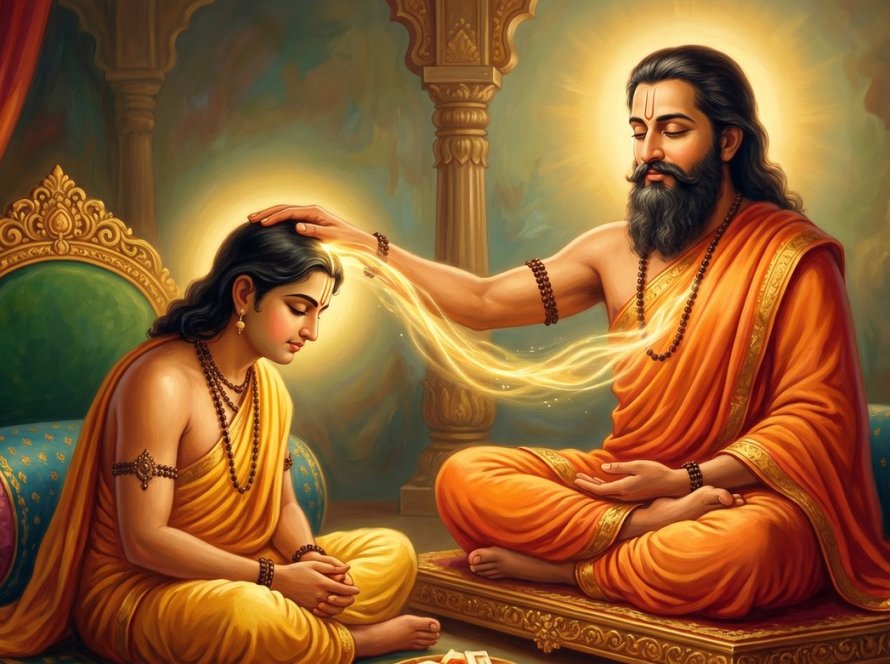
The Satguru gives the disciple a sequence of techniques to practise — the Omkar Kriya, the Maha Mudra, the Nabhi Kriya, the piercing of the Vishnu and Rudra granthis, and finally Paravastha, a foretaste of samadhi. But the techniques are only the outer work. The inner work is svadhyaya: self-study. And that raises a question most practitioners never stop to ask.
Who studies whom?
"You feel that you are doing the Kriya Yoga, and you are only one," Gurunath observes. But as the mind is refined by constant practice, a subtler truth comes into view. There is not one of you, but two: the one who watches, and the one who is watched.
The Atma studies the buddhi, which is the mind. The Atma is the witness. The subject studies the object — and the mind is nothing more than an object.— Yogiraj Gurunath Siddhanath
This is the key that unlocks svadhyaya. The Atma — the silent Self, ever still, perfect and enlightened — is the witness within you. The mind is a continuous flow of thoughts, an object that can be observed and trained. Self-study, then, is not the mind examining itself in an endless loop. It is the witness quietly observing the mind.
The Atma watches; the mind is purified
Remarkably, the witness does nothing. "Although the Atma does nothing to the mind, it just witnesses the random thoughts of the mind," Gurunath explains. And yet that pure witnessing is itself the cause of purification. The focused attention of the Self is what slowly cleanses the buddhi.
So when you practise — when you do your breathing, your Maha Mudra, your Nabhi Kriya with body, emotions and mind — the real instruction is simply this: remember the watcher. Behind every movement of the body and every ripple of thought, there is one silent watcher, your subjective Self, looking on.
Distraction versus integration
Behind the buddhi stands the ego, forever tempting it outward. Gurunath gives the ego a voice we all recognise: "No, no, let's not do 144 kriyas today. Let's just do seventy, or none at all — there's a party going on over there." Anything that pulls the witness out into scattered, outward activity he calls distractive, dispersive activity. Anything that gathers the mind back toward pure stillness is atmic activity.
Svadhyaya is the steady work of choosing the second over the first — again and again.
Washing the mud from the mind
The word itself tells the story: swa means self, adhyaya means study. Here the "self" being studied is the mind — and the aim is to discipline and cleanse it. This cleansing has a name in the tradition: chitta-shuddhi, purification of the mind-stuff.
Unless the mud of the mind is washed off, you cannot know the Self.— Yogiraj Gurunath Siddhanath
Two kinds of mind
Gurunath distinguishes two currents of mind. There is the outward-flowing mind, pravritti, which runs toward the world; and the inward-flowing mind, nivritti, which turns always toward Ram, Krishna and Lord Shiva. The path of the yogi is the path of nivritti — the inward-flowing mind.
He adds an important clarification. The old categories — Brahmin, Kshatriya, Shudra — are not jati, not accidents of birth. "It is the state of minds," he insists. They describe where a person's mind habitually rests, not the family they were born into. To live with an inward-flowing mind is to live the nivritti dharma.
The ego is not always the enemy
There is a surprising turn here. The ego, Gurunath says, is not always bad. When you take up the techniques, use the sat-buddhi — the pure, sattvic intellect — and let some of the good ego support it. That refined ego is what gets you onto the mat every day. Meanwhile the Atma simply watches: "When you bend down, the Atma is still watching, seeing your physical body go up and down. Behind you, the Atma is watching."
And because the witness can neither study nor be studied by any object — not by buddhi, not by manas — something quiet and extraordinary happens. By the mere presence of the Atma, the buddhi and the ego refine themselves. The more refined they become, the more sincerely the practice deepens.
When the buddhi realises it is not the Self
For a long time the ego whispers to the intellect: you are the king, you are the doer, you are the Atma. But through faithful svadhyaya, a day comes when the buddhi sees through it. Having tasted the still, thought-free tranquillity that the Satguru gives in Paravastha, the buddhi realises: "There is somebody behind me — that is my true Self, and I am only the puppet."
In that recognition the buddhi is purified, and what was bound is released — freed from bondage by its own effort, in the presence of the ever-watching Atma.
Your activities are so tumultuous that, in the ripples of your mind's lake, you cannot see the moon of the Atma.— Yogiraj Gurunath Siddhanath
Still the lake, and the moon appears. That is svadhyaya.
Hamsa Info is an independent, non-commercial resource. The actual Kriya techniques referred to here are given directly by the Satguru at initiation and are not taught online.