One Truth, Many Scriptures
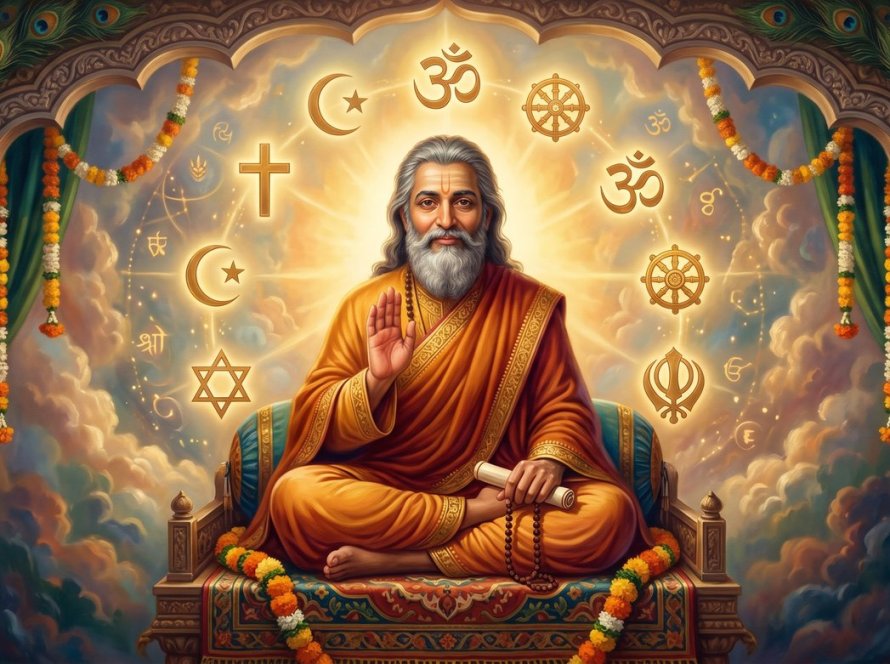
When Sri Yukteswar wrote The Holy Science in 1894, he set himself a bold task: to show that the Christian gospels and the Hindu scriptures, far from contradicting one another, teach the very same path to God. “There is an essential unity,” he wrote, beneath the surface differences of the world’s faiths.
One goal behind many forms
Sri Yukteswar held that every true religion arises from the same source and aims at the same goal — the realisation of our oneness with the Divine. The outer forms differ because they arose among different peoples in different ages, but the inner aim is identical. To quarrel over forms is to miss the shared destination.
The four foundations
In The Holy Science he organised the spiritual journey around four great questions: the nature of God and creation, the goal of life, the method of attaining it, and the revelation that crowns it. He drew on the Bible and the Sanatana Dharma side by side, showing each illuminating the other.
An echo of Ramakrishna
This vision harmonises beautifully with the realisation of Sri Ramakrishna, who reached God through the disciplines of many faiths and declared, “As many faiths, so many paths.” Both saints testify, from direct experience, that the mountain of God has many trails but one summit.
Why it matters today
In an age torn by religious division, this teaching is a quiet revolution. It asks us to honour all sincere paths, to seek the experience behind the doctrine, and to recognise the one Light shining through every true scripture. For the Kriya yogi, it is permission to draw nourishment from all the wisdom of humanity while walking one’s own chosen path with devotion. Explore the great texts and the Bhagavad Gita to see this unity for yourself.