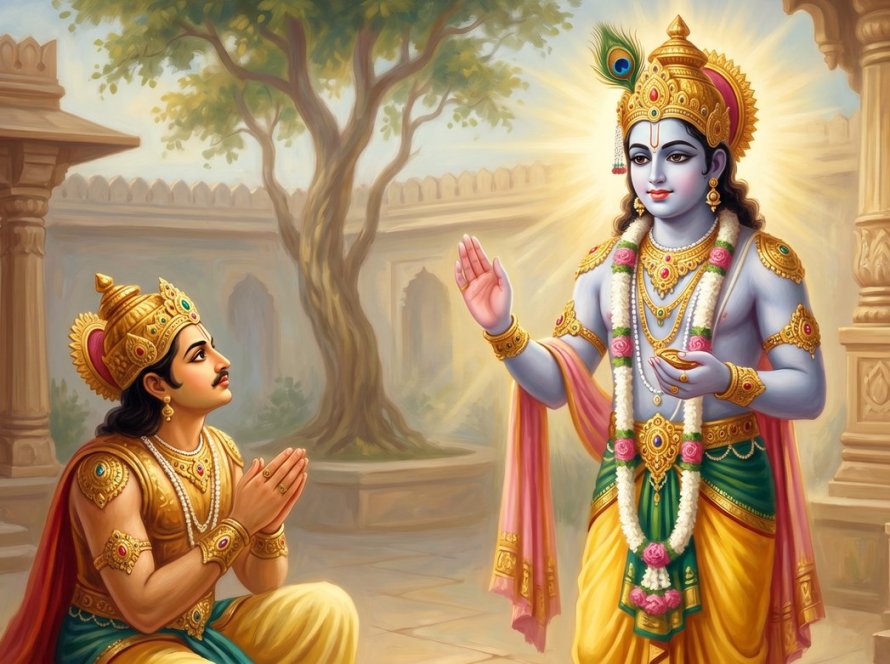
The Bhagavad Gita— Chapter 1: Arjuna-Vishada Yoga (The Yoga of Arjuna’s Despair)
The first chapter of the Bhagavad Gita, Arjuna-Vishada Yoga (“The Yoga of Arjuna’s Despair”), sets the stage for the entire dialogue. Its 47 verses describe the moment a great warrior’s courage collapses into grief — and in that collapse, the spiritual teaching of the Gita is born.
The setting
The blind king Dhritarashtra asks his minister Sanjaya to describe the battlefield of Kurukshetra, where the armies of the Pandavas and Kauravas stand ready for war. Conches are blown, banners raised. Arjuna asks Krishna, his charioteer, to draw the chariot into the space between the two armies so he may see those he must fight.
Arjuna’s despair
There Arjuna sees fathers, grandfathers, teachers, uncles, cousins and friends arrayed on both sides. Overwhelmed with sorrow and pity, his limbs fail, his bow Gandiva slips from his hand, and his mind reels. He cannot bear the thought of killing his own kin for the sake of a kingdom. “I will not fight,” he says, and sinks down in the chariot, his heart overcome with grief.
The deeper meaning
This chapter is not really about war. Arjuna’s crisis is the universal human crisis — the moment a sincere soul, facing the hard duties of life, is paralysed by confusion and sorrow. His honest despair is the necessary beginning: only when our own resources fail do we truly turn to the Divine for guidance. The Kriya masters read Arjuna as the aspiring devotee and the battlefield as the field of the soul, where the higher and lower tendencies meet.
Why it matters
Chapter 1 teaches that spiritual life often begins in a moment of breakdown, not triumph. Arjuna’s willingness to admit “I do not know what is right; I am your disciple; teach me” (the cry that opens Chapter 2) is the doorway through which all of Krishna’s wisdom can flow. Read the full overview on our Bhagavad Gita page, or continue to Chapter 2, Sankhya Yoga.
This is part of our complete Bhagavad Gita summary of all 18 chapters.