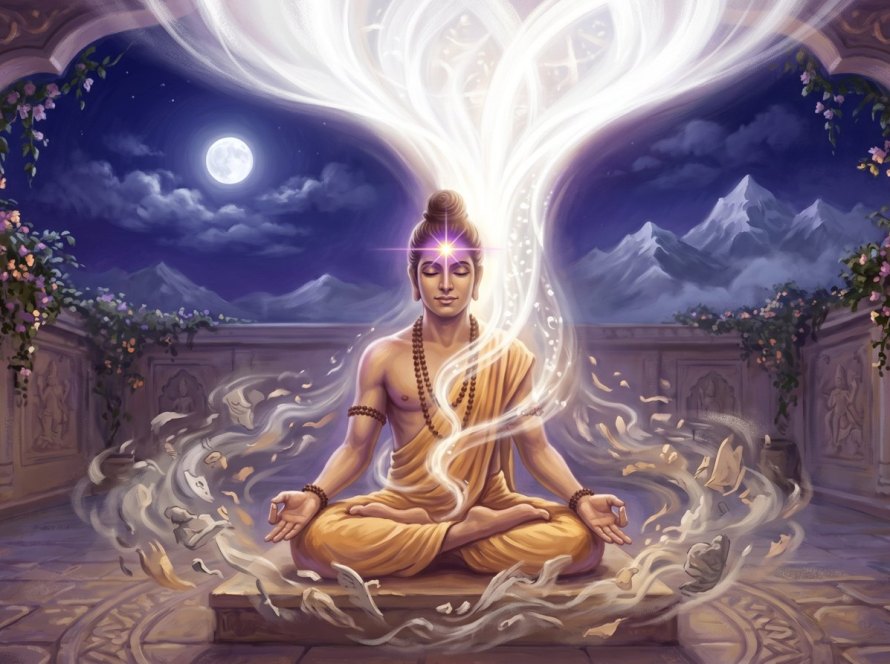
The Threefold Path of Kriya Yoga
A Scientific and Devotional Approach to Self-Realization
The Threefold Path of Kriya Yoga
Life is short. Time is fleeting.
If we are to realize our Divine Indweller, we require a method that is systematic, succinct, and organized — not vague inspiration, not occasional practice, but a living discipline.
In the sacred Yoga Sutras of Patanjali, Kriya Yoga is clearly defined as a threefold path:
-
Tapa
-
Svadhyaya (Abhyas)
These three are not separate from the Kriya Yoga we practice today. They are its foundation. They ensure that Kriya Yoga is not reduced to technique alone, but remains a complete path of transformation.
Tapa — The Discipline That Builds Inner Fire
Tapa means self-directed austerity — sacred discipline applied to daily life.
It is:
-
Rising at a set time.
-
Cleansing and preparing the body.
-
Sitting for meditation at the same hour each day.
-
Completing your allotted Kriyas — whether 72 or 144.
-
Practicing Mahamudra regularly and without fail.
This steady repetition creates a vortex of energy in your meditation space. Over time, the body becomes conditioned, the spine becomes charged, and the breath becomes more refined.
Tapa generates spiritual heat. That inner heat purifies the mind, strengthens the aura, and builds subtle electricity in the spine.
Without discipline, Kriya Yoga does not mature.
With discipline, transformation becomes inevitable.
Svadhyaya — Constant Inner Schooling
Svadhyaya means self-study, but not merely reading scriptures. It is the continuous schooling of the mind through repetition and awareness.
It is:
-
Daily Kriya practice.
-
Returning attention to the breath again and again.
-
Observing thoughts and dismissing distractions.
-
Binding inwardly to the Guru’s guidance.
Each time the mind wanders and you bring it back, that inner effort (jatan) builds strength. Over time, the breath slows, concentration deepens, and clarity increases.
Your true wealth is not possessions.
Your true wealth is how many conscious breaths you have lived.
Consistency transforms effort into realization.
Ishvara Pranidhana — The Heart of Devotion
Some believe Kriya Yoga is purely technical — Mahamudra, Omkar Kriya, breath control practices.
But Kriya Yoga is not devoid of devotion.
Ishvara Pranidhana means offering your whole body, mind, and soul to the Divine and to the Satguru.
Chanting opens the lotus of the heart.
Devotion softens the ego.
Surrender deepens the breath.
Even while practicing scientific techniques, devotion must accompany the practice. The heart and the spine must awaken together.
When discipline, self-study, and surrender unite, Kriya Yoga becomes both scientific and devotional — balanced and complete.
A Complete Path
Kriya Yoga is not merely something we perform. It is something we live.
Through:
-
Tapa — disciplined effort
-
Svadhyaya — constant inner refinement
-
Ishvara Pranidhana — humble surrender
the practitioner moves toward Self-Realization and, ultimately, God-Realization.
Every Kriya breath is sacred.
Every disciplined sitting strengthens the spine of awareness.
Every act of surrender dissolves ego and reveals the indwelling Light.
This is the threefold path of Kriya Yoga — simple in structure, profound in transformation.